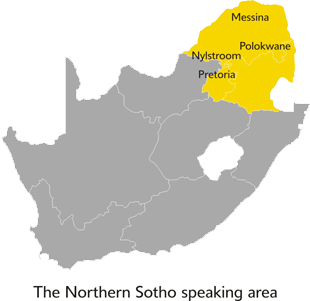
Sesotho sa Leboa is a Sotho-Tswana language group spoken in the northeastern provinces of South Africa, most commonly in the Mpumalanga, Gauteng and Limpopo provinces. It is also known by Pedi or Sepedi and holds the status of an official language in South Africa.
An official language for the Lebowa homeland during apartheid, it is the first language of over 4.6 million (9.1%) people according to the South African National Census of 2011, making it the 5th most spoken language in South Africa.
Official language status
Sepedi vs Northern Sotho
According to Chapter 1, Section 6 of the South African Constitution, Sepedi is one of South Africa's 12 official languages. There has been significant debate about whether Northern Sotho should be used instead of Pedi. The English version of the South African Constitution lists Sepedi as an official language, while the Sepedi or Northern Sotho version of the Constitution of South Africa lists Sesotho sa Lebowa as an official South African language.
South Africa's official language policy
South Africa's official language policy refers to the eleven official languages of South Africa (i.e., Sepedi, Sesotho, Setswana, siSwati, Tshivenda, Xitsonga, Afrikaans, isiNdebele, isiXhosa, isiZulu and English), as specified in the Constitution of the Republic of South Africa.
Name
The Northern Sotho written language was based largely on the Sepedi dialect. Missionaries studied this dialect the most closely and first developed the orthography in 1860 by Alexander Merensky, Grutzner, and Gerlachshoop. This subsequently provided a common writing system for 20 or more varieties of the Sotho-Tswana languages spoken in the former Transvaal, and also helped lead to "Sepedi" being used as the umbrella term for the entire language family. However, there are objections to this synecdoche by other Northern Sotho dialect speakers, such as speakers of Modjadji's Lobedu dialect.
Other varieties of Northern Sotho
Northern Sotho can be subdivided into Highveld-Sotho, which consists of comparatively recent immigrants mostly from the west and southwest parts of South Africa, and Lowveld-Sotho, which consists of a combination of immigrants from the north of South Africa and Sotho inhabitants of longer standing. Like other Sotho-Tswana people, their languages are named after totemic animals and, sometimes, by alternating or combining these with the names of famous chiefs.
The Highveld-Sotho
The group consists of the following dialects:
- Bapedi
- Bapedi Marota (in the narrower sense)
- Marota Mamone
- Marota Mohlaletsi
- Batau Bapedi (Matlebjane, Masemola, Marishane, Batau ba Manganeng - Nkadimeng, Kgaphola, Diphofa, Nchabeleng, Mogashoa, Phaahla, Sloane, Mashegoana, Mphanama)
- Phokwane
- Bakone
- Kone (Ga-Matlala)
- Dikgale
- Baphuthi
- Baroka
- Bakgaga (Mphahlele, Maake, and Mothapo)
- Chuene
- Mathabatha
- Maserumule
- Tlou (Ga-Molepo)
- Thobejane (Ga-Mafefe)
- Batlokwa
- Batlokwa Ba Lethebe
- Makgoba
- Batlou
- Bahananwa (Ga-Mmalebogo)
- Moremi
- Motlhatlhana
- Babirwa
- Batswapong
- Mmamabolo
- Bamongatane
- Bakwena ba Moletjie (Moloto)
- Batlhaloga
- Bahwaduba, BaGaMagale, and many others
The Lowveld-Sotho
The group consists of Lobedu, Narene, Phalaborwa (Malatji), Mogoboya, Kone, Kgaga, Pulana, Pai, Ramafalo, Mohale and Kutswe.
Classification
Northern Sotho is one of the Sotho languages of the Bantu family. Although Northern Sotho shares the name Sotho with Southern Sotho, the two groups also have a great deal in common with their sister language Setswana. Northern Sotho is also closely related to Setswana, sheKgalagari and siLozi. It is a standardized variety, amalgamating several distinct varieties or dialects. Northern Sotho is also spoken by the Mohlala people.
Most Khelobedu speakers only learn to speak Sepedi at school, such that Sepedi is only their second or third language. Khelobedu is a written language. Lobedu is spoken by a majority of people in the Greater Tzaneen, Greater Letaba, and BaPhalaborwa municipalities, and a minority in Greater Giyani municipality, as well as in the Limpopo Province and Tembisa township in Gauteng. Its speakers are known as the Balobedu.
Sepulana (also sePulane) exists in unwritten form and forms part of the standard Northern Sotho. Sepulana is spoken in Bushbuckridge area by the MaPulana people.
Writing system
Sepedi is written in the Latin alphabet. The letter š is used to represent the sound [ʃ] ("sh" is used in the trigraph "tsh" to represent an aspirated ts sound). The circumflex accent can be added to the letters e and o to distinguish their different sounds, but it is mostly used in language reference books. Some word prefixes, especially in verbs, are written separately from the stem.
Phonology
Vowels
Consonants
Other consonant sounds include fricative-combinations /pʃʼ pʃʰ fʃ βʒ/ and /psʼ psʰ fs/.
Within nasal consonant compounds, the first nasal consonant sound is recognized as syllabic. Words such as nthuše "help me", are pronounced as [n̩tʰuʃe]. /n/ can also be pronounced as /ŋ/ following a velar consonant.
Urban varieties of Northern Sotho, such as Pretoria Sotho (actually a derivative of Tswana), have acquired clicks in an ongoing process of such sounds spreading from Nguni languages.
Vocabulary
Some examples of Northern Sotho words and phrases:
Sample text
Universal Declaration of Human Rights
See also
- Pedi people
- Lebowa
- Sekhukhuneland
Notes
External links
- Dryer, Matthew S.; Haspelmath, Martin, eds. (2013). "Northern Sotho". World Atlas of Language Structures Online. Max Planck Institute for Evolutionary Anthropology.
- The Universal Declaration of Human Rights in Northern Sotho
- Online Northern Sotho – English dictionary
- Online Northern Sotho explanatory dictionary
- Pan South African Language Board
- Audio files in Pedi at Wikimedia Commons
Software
- Spell checker for OpenOffice.org and Mozilla, OpenOffice.org, Mozilla Firefox web-browser, and Mozilla Thunderbird email program in Northern Sotho
- Translate.org.za Project to translate Free and Open Source Software into all the official languages of South Africa including Northern Sotho
- Keyboard with extra Northern Sotho characters